 Wakeloom
The usual traps when copying the leaderboard: the top spot came from one big bet, unrealized gains are counted in the rank, the board mixes in market makers and wash traders, and you always order later than they did, after the price has moved. Some traps are on your side: wrong position sizing, or missing their exit. Here's how to spot and avoid each.
The #1 spot came from one big bet
Profit-sorted boards love the person who hit one large event. Maybe it was a great call, maybe luck; one trade can't tell you which.
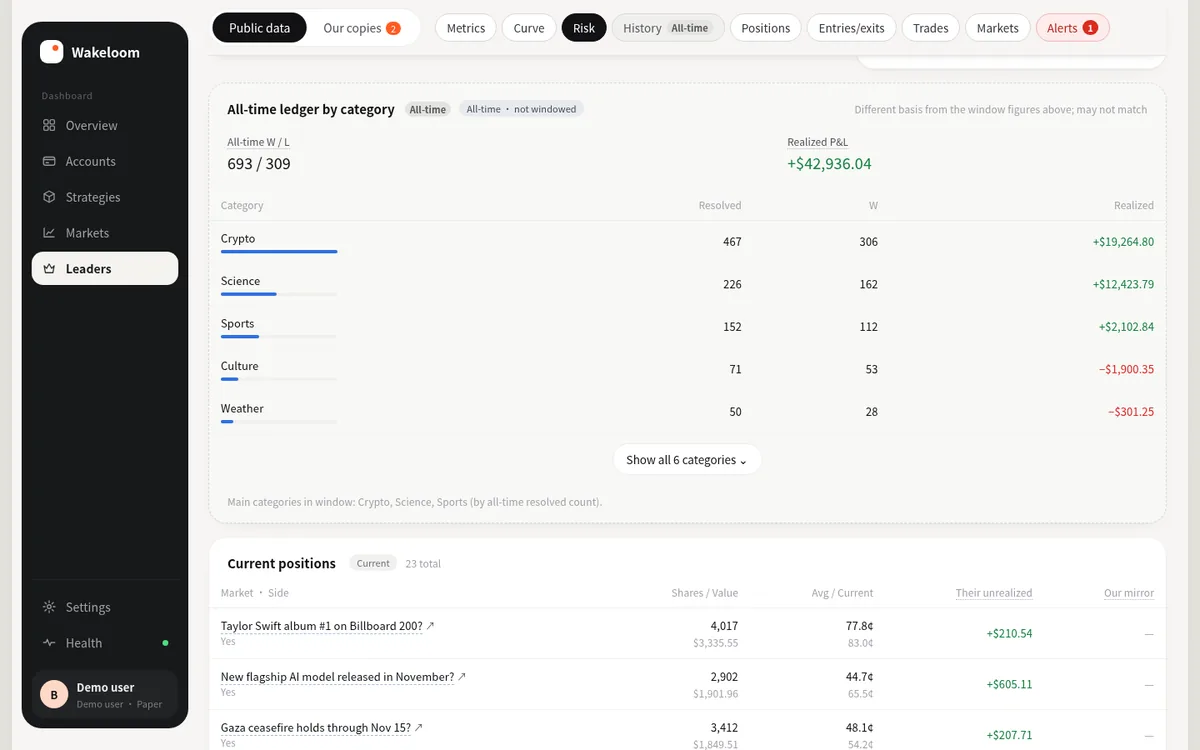
Check profit concentration. How much of the profit comes from the biggest event? Take it out; is the rest still positive? If nearly all of it comes from one event, that rank is hard to repeat.
Unrealized gains are in the rank
Some boards mark open positions to the current price. Someone holding a big position that moves their way climbs the board; when the price comes back, they drop. Follow them at #1 and you may be following a position that hasn't resolved.
Look at realized and unrealized PnL separately, and at the number of resolved markets (counted over full history). Many resolved markets plus positive realized PnL is a sturdier record.
You can't copy market makers
Some wallets quote both sides of a market and earn the spread at their resting prices. Volume is high and returns can look steady.
You can't follow them. By the time you see their fill, you're taking someone else's quote, not getting their price, and you can lose on the spread even when the direction is right. Leave wallets with a high share of two-sided quoting off your copy list. On Wakeloom, suspected market-maker addresses are not ranked. This check is still being filled in, so take a second look yourself before copying.
Wash traders' numbers are manufactured
Volume far beyond profit, or trades against itself, means volume and rank may be inflated. Big volume isn't skill. Leave these off too.
Wakeloom scores wallets against thresholds such as profit concentration and wash trading; wallets that fail get no overall score. These checks are still being filled in, so whichever leaderboard you use, Wakeloom's included, check market making, wash trading and single-event concentration yourself. See How it works.
You always order after they do
Copying means you order after you see their fill, so there's always delay: spotting the fill, confirming, submitting.
Many Polymarket order books are thin. The price can move during that delay, and your order may eat several levels of the book, so your average price is worse than theirs. The cheaper they bought, the thinner the market and the faster they trade, the bigger the gap.
Check median hold time and order-book depth. Short holders who trade obscure markets usually show the widest gap between their results and their copiers'.
Wakeloom's paper trading fills against the live order book at the moment the leader's trade is seen, records the price gap on every trade, and skips the trade if the gap exceeds a threshold (3% by default, adjustable). It all happens on paper, with no real money. You see how much the spread eats before deciding whether to keep following.
Copy the entry price, not only the wallet. If you arrive later into a thin book, the leader's edge can become your slippage. Compare the fill you would have gotten with the fill they got, and set a deviation limit so that an oversized gap is skipped rather than copied. Wakeloom's paper trading does this on a simulated book after the leader's fill is seen, and records the gap, the delay and an estimated fee. A dated public example of that log is not on this page, so treat the mechanism as a checklist, not as a measured 30-second case study.
More on how the paper simulator runs: Paper-trade copy trading for Polymarket. Can delay and slippage make copy trading lose money? Yes; see the FAQ.
Fees and costs left out
Some markets charge trading fees; check Polymarket's official documentation. The PnL on the board is theirs. Yours comes after your own fees, spread and delay. Compare numbers after costs.
Copying their position size
A drawdown a whale can absorb may be too much for you. A small slice of their capital, copied at the same dollar amount, can be a big chunk of yours.
Copy proportionally and cap each trade and each market. That matters more than finding "the best trader".
They exited and you didn't
Copy entries but not exits and your results will look nothing like theirs. They've taken profit or cut the loss; you're still holding whatever happens next.
Your copy rules should include following reductions and closes. Wakeloom's paper trading scales down or closes in proportion when the leader does. What if they close? Close too; see the FAQ.
Using a stale leaderboard
A leaderboard is a snapshot. On a board from a week ago, people may have already changed style. Check the as-of time on the board and on the wallet page separately; they can differ when a snapshot is stale.
The Wakeloom leaderboard is sorted by overall score (smart_score), every page shows its own data timestamp. Win rate (last 90 days) and ROI (last 90 days) are shown for reference only, not used for ranking.
Why a copier's result is not the leader's PnL
Is copy trading on Polymarket profitable? It can be, and it can also lose money. Following every signal is not enough.
The number on a profile or a leaderboard is the leader's result, not yours. Typical gaps:
- Different entry prices. You always trade after you see their fill. On a thin book the price may already have moved, so your average price is worse.
- Different size and bankroll. A drawdown they can sit through may be too large for you at the same dollar size. Copy proportionally and cap each trade and each market.
- Delay and skipped trades. If a gap exceeds your deviation limit, you skip; your path then diverges from theirs. If you copy entries but miss exits, it diverges further.
- Costs. Your result comes after spread, delay and your own fees. Some published PnL figures do not make those costs obvious. Wakeloom records an estimated taker fee on paper fills; it does not offer a full fee or rebate reconciliation, and it does not treat a profile PnL as "profit after fees."
- What doesn't copy. A strategy can depend on inventory, maker pricing, rewards, or a style that breaks when it is mirrored. Realized leaderboard profit also may hide risk still sitting in open positions.
None of this is a forecast of how often copiers win or lose. Figures circulating online about copier loss rates have not been verified here and are not used on this page.
The cautious sequence is: rule out wallets you cannot really copy, size the copy to your own bankroll, then paper-trade long enough to read the gap, delay and fee log. Wakeloom currently offers that paper-trading analysis only and is not live. See Paper-trade copy trading for Polymarket.
Summary
A leaderboard is good for finding names and risky to copy blindly. Rule out big-bet, market-maker and wash-traded wallets, check resolved markets and drawdown, then paper-copy to see what's left after spread and costs. Wakeloom is not live yet and offers paper-trading analysis only. Results are for research only and are not investment advice. Past results don't predict future ones.